
Content System for Photographers | One Take
How I Turned One Voice Note Into a Full Marketing Package for Every Session
I used to finish a session, drive home with my head full of details and feelings about what just happened, and then lose all of it. Not the files. The story. The specific thing a mom said while her daughters walked ahead of her on the trail. The reason we changed locations. The moment a senior finally stopped performing and just existed in front of me. All of that would fade by the time I sat down to write a caption, and I would end up posting something generic that could have been about anyone. That gap is why I built One Take, a content system for photographers that turns one voice note into a complete marketing package while the details are still fresh.
That gap between what I experienced and what I published was costing me. Not just in engagement, but in the kind of clients I was attracting. When your content sounds like everyone else’s content, you get inquiries from people who think all photographers are interchangeable.
So I built something to fix it.
What Is One Take? A Content System for Photographers
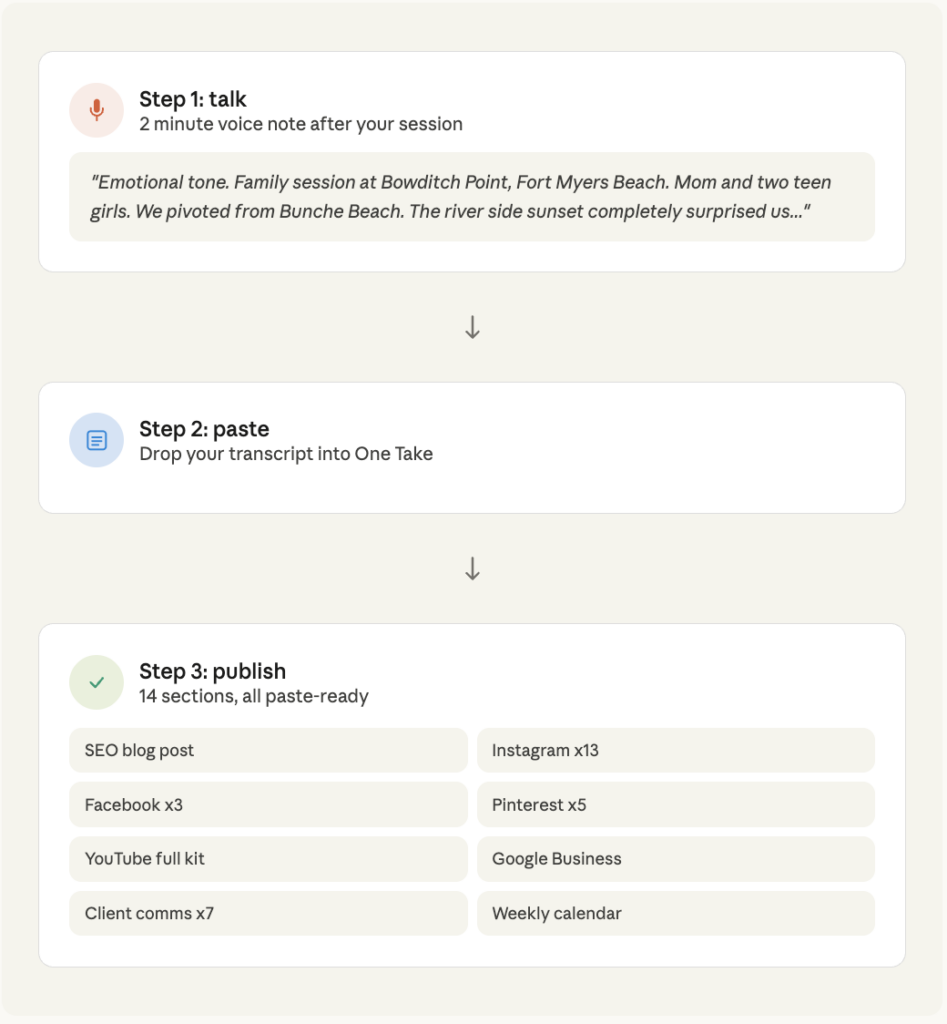
One Take is a content system for photographers that I built for my own business, Kellie Rochelle Photography, and then refined until it worked for any niche. The idea is simple. You finish a session, you talk into your phone for two minutes while the details are fresh, and One Take turns that voice note into a complete marketing package you can copy and paste across every platform you use.
Not a caption. Not a blog outline. A full package.
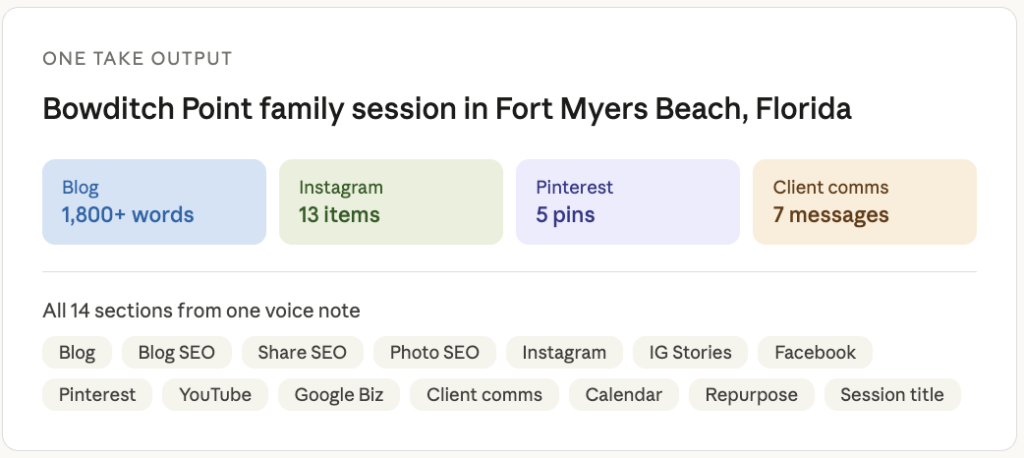
We are talking a finished blog post with SEO built in, Instagram captions in multiple lengths, Facebook posts, Pinterest pins, YouTube descriptions with chapters and tags, Google Business Profile posts with Q&A seeds, client communication templates, a weekly posting calendar, and a content repurposing plan that shows you how one blog post turns into a month of content.
Fourteen sections total. Every one of them paste-ready.
Why I Built This Instead of Just Using Templates
I tried templates. I tried content calendars. I tried batching captions on Sundays. Every system I used had the same problem: it stripped out the specifics.
Templates gave me “Had the best time with this family at golden hour” when what actually happened was a mom tearing up because her 14-year-old still reached for her hand on a trail, unprompted, and I watched it happen from ten feet back knowing that is the kind of thing that disappears in a year.
The specifics are what make people stop scrolling. The specifics are what make Google rank your blog over someone else’s. The specifics are what make a potential client read your caption and think, “That is the photographer who will actually see my family.”
One Take is built to protect those specifics. You record them while they are still warm, and the system structures them into every platform format you need without sanding off the details that made the session yours.
How This Content System for Photographers Actually Works
You finish a session. You open your phone and talk. You say the tone you want (emotional, funny, or hype), then you dump everything you remember. The location, what went differently than planned, what the client wore, the moment that made you feel something, the logistical detail that surprised you, the age of the kids, the name of the park, whatever is in your head.
That is your one take. You do not edit it. You do not outline it. You just talk.
Then you paste that transcript into One Take, and it generates the full package. Blog post, captions, SEO metadata, client emails, everything. Written in first person as you. Not in some generic marketing voice. In the way you actually think about your sessions.
This content system for photographers adapts to whatever session type you just finished. Senior sessions get Senior Sunday content, school keywords, and energetic language. Family sessions lean warm and nostalgic with Facebook as the priority platform. Newborn sessions shift to nurturing, safety-aware language aimed at parent groups. Wedding sessions center the venue for SEO and prioritize Pinterest. Branding sessions focus on ROI language and LinkedIn.
You do not have to tell it any of that. It reads your notes and figures it out.
What Photographers Get Wrong About Content
Most photographers treat content as a task that happens after the creative work is done. Shoot the session, cull the gallery, edit the favorites, deliver to the client, and then, if there is any energy left, write something for Instagram.
By that point the session is a week old. The details have blurred. You remember that the light was nice and the client was sweet, but you cannot remember the name of the trail or what the daughter said that made everyone laugh or why you decided to stay on the east side of the park instead of walking to the beach.
So you write something forgettable. And forgettable content attracts forgettable inquiries.
The fix is not working harder at content. The fix is capturing the story when it is still alive and letting a system do the formatting. That is what One Take does. It moves the creative part of content creation to the moment right after the session, when you are still feeling it, and automates the structural part that eats your evening.
If you want to see what story-driven session content looks like in practice, read one of my recent branding session blog posts, Isabel’s Branding Session or browse Danyn’s Senior Session.
What Comes in the Package
Every One Take output follows the same 14-section structure.
The blog post is the anchor. Minimum 1,500 words, written in narrative first person, with SEO baked into the structure. It opens with a direct answer paragraph that Google and AI search systems can extract. It includes H2 headings phrased as questions your ideal client would actually type into a search bar. It ends with an FAQ section using real client language. Internal and external links are placed naturally throughout.
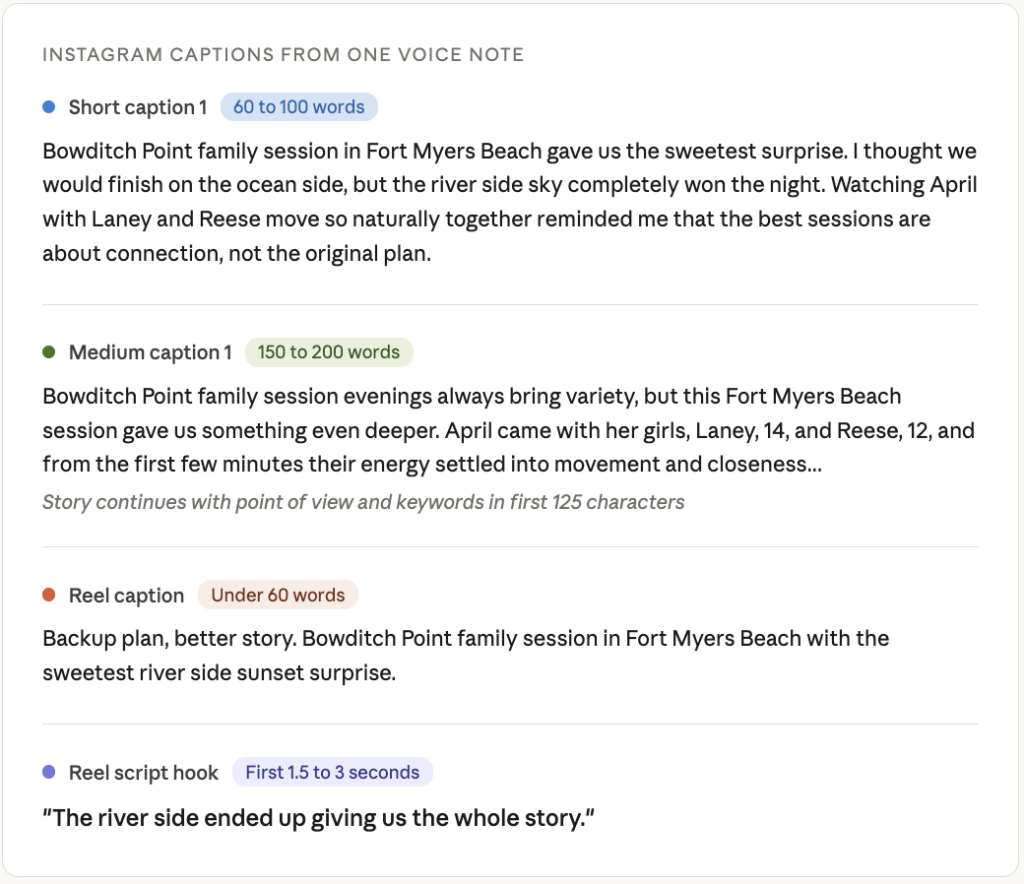
From there the system builds platform-specific content. Instagram gets two short captions, two medium captions, a Reel caption with a hook, and hashtag sets. Facebook gets a short version and an extended version. Pinterest gets five pins from different keyword angles, each with a board suggestion. YouTube gets a title, description, chapter timestamps, and tags. Google Business Profile gets a post and five Q&A seeds.
Client communications are included too. A sneak peek text to send within 48 hours. A review request timed for after gallery delivery. A referral request timed for a few weeks later. An email with a subject line and full body. All written in your voice, referencing specific details from the session so your client feels seen, not templated.
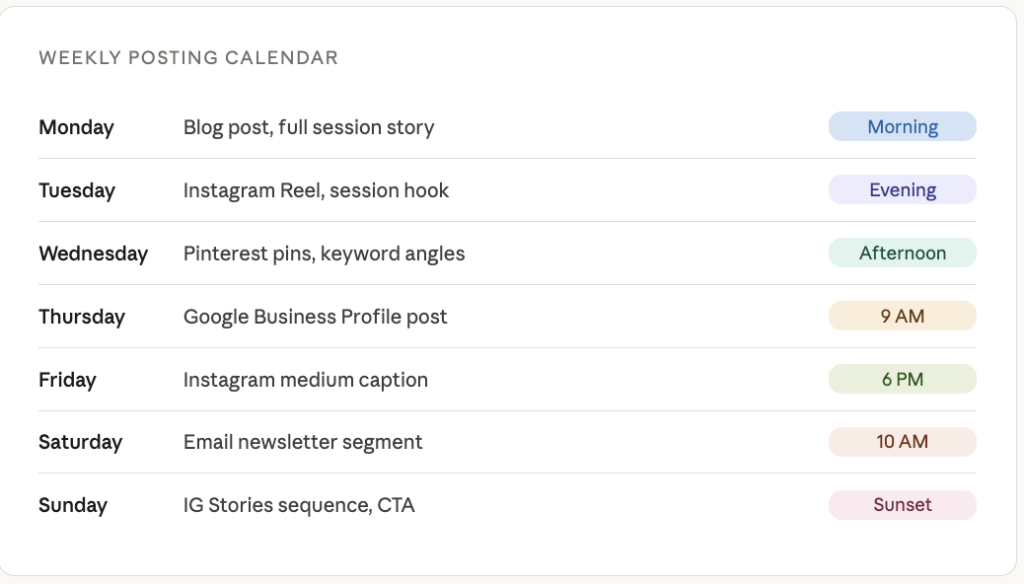
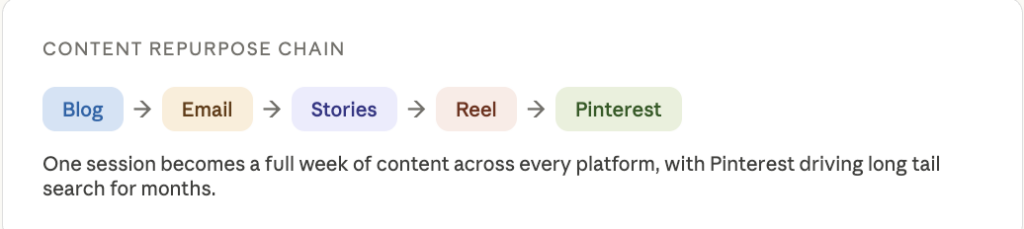
The posting calendar maps out your week. The content repurpose section shows you how the blog feeds your email list, which feeds your Stories, which feeds your Reel, which feeds your Pinterest reach for months.
Who This Is For
If you are a photographer who knows your work is good but your content does not reflect it, this is for you.
If you are spending Sunday nights staring at a blank caption box trying to remember what happened at a session two weeks ago, this is for you.
If you have been told you need to blog for SEO but you would rather reshoot an entire wedding in the rain than write 1,500 words about one, this is for you.
If you are booking clients but they all found you through referrals and none of them found you through Google, this is for you.
One Take does not replace your voice. It structures it. You still have to show up to the session and pay attention to what matters. You still have to talk into your phone afterward and say what you noticed. The system handles everything after that. That is what a content system for photographers should do, protect your voice and give it structure.
Whether you are a family photographer, a senior photographer, or a branding photographer, the system adapts to your niche and your voice.
Why Every Content System for Photographers Fails Without Specifics
The hidden cost of inconsistent content is not just lower engagement. It is identity erosion. When you post sporadically, when your captions are generic, when your blog has not been updated in months, potential clients cannot figure out what makes you different. They see your work and think it is pretty, but they do not feel a point of view. So they book based on price, or availability, or whoever responds first.
Consistent, specific, story-driven content does something templates never will. It builds a body of evidence that you see things other photographers miss. Every blog post, every caption, every Story frame becomes proof that you are paying attention. And the clients who value that, the ones who want more than a pretty picture, they find you because of it.
That is what One Take protects. Not just your time. Your perspective.
If you want to learn more about how content marketing and SEO work together for photographers, Fuel Your Photos and The Milky Way are two great resources to explore.
Try One Take
One Take is available now for photographers in any niche.
[LINK: your ThriveCart sales page URL here]
If you have questions about how it works or want to see sample output from a real session, reach out through my website at www.kellierochelle.com. I am happy to walk you through it.
Frequently Asked Questions About One Take for Photographers
Do I need to be technical to use this content system for photographers?
No. If you can talk into your phone and paste text into a box, you can use One Take. There is no setup, no software to install, and no learning curve. You record your voice notes, paste them in, and get your full content package back in minutes.
What if my session notes are really short?
One Take still generates the full 14-section package. If your notes are thin, the system flags specific gaps with placeholders so you know exactly where to add detail. You get a complete draft either way, never a blank page.
Does it work for session types other than portraits?
Yes. One Take adapts to seniors, families, newborns, maternity, weddings, engagements, branding, headshots, lifestyle, sports, and more. It detects the session type from your notes and adjusts tone, keywords, platform priorities, and client communication style automatically.
Will my content sound like AI wrote it?
No. This content system for photographers is built around your voice notes, not generic prompts. The details, emotions, and observations come from you. One Take structures and formats them, but the perspective and personality stay yours. The output reads like you sat down and wrote it yourself on your best writing day.
you love our work and you're
Ready to capture this season?
I usually book a few months out, but it’s always worth reaching out. Filling out the inquiry form gives me a sense of what you’re looking for and whether the timing works.
book now
